
Start an interview
Pick the role you're chasing. Your interviewer studies it and your resume together, then tailors every question to you.
How it works
From picking a role to reading your debrief. Your interview is ready in about a minute.
Choose your role
Search the list or browse by category. The job description behind each role is already written, so there is nothing to paste and nothing to write. Not listed? Type your own and it works the same way.
Roles across 8 fields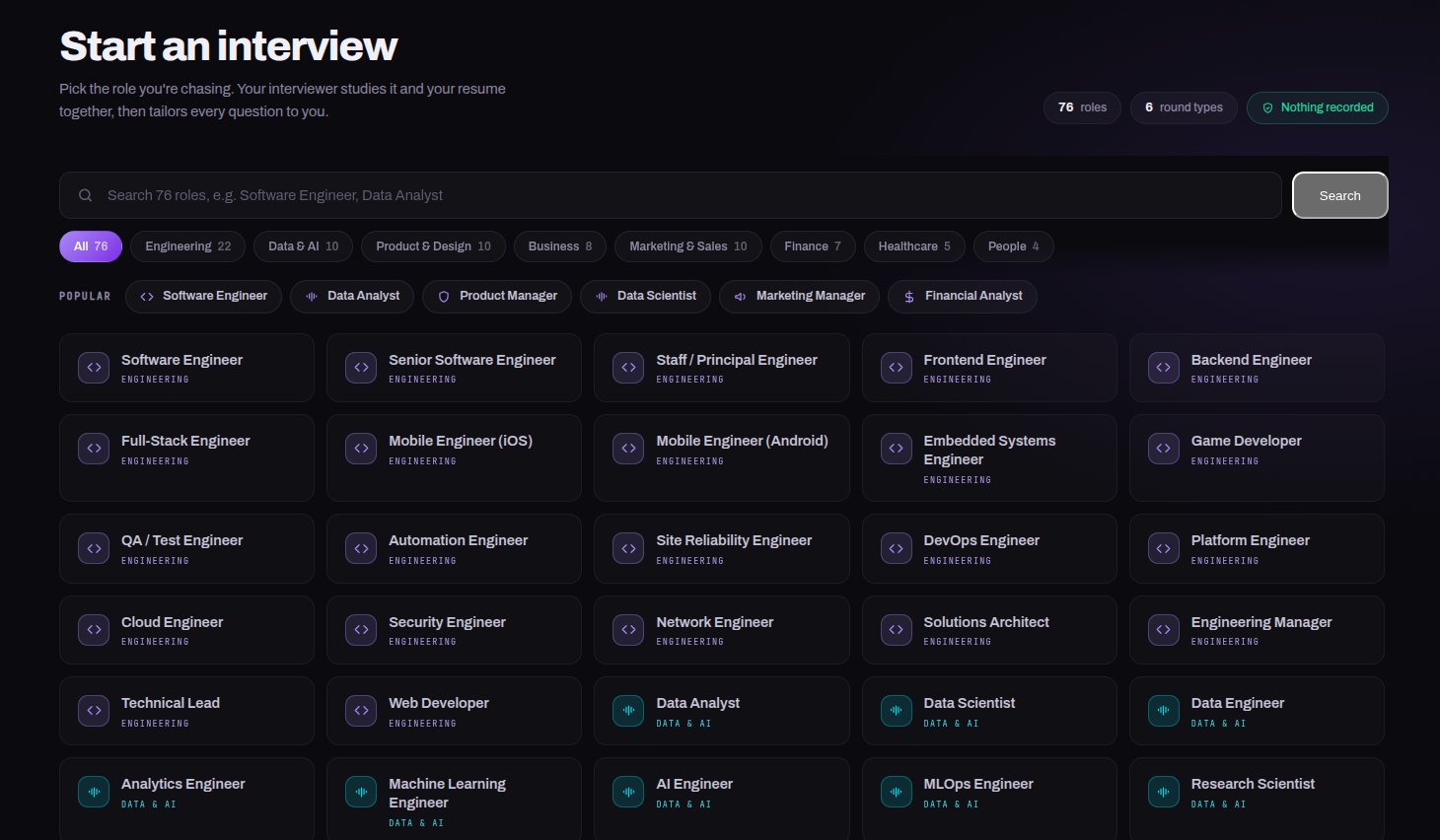
Set the round and difficulty
Pick the kind of round, where the difficulty opens, and whether your interviewer is collaborative or strict. Add your resume so the questions come from work you have actually done.
6 round types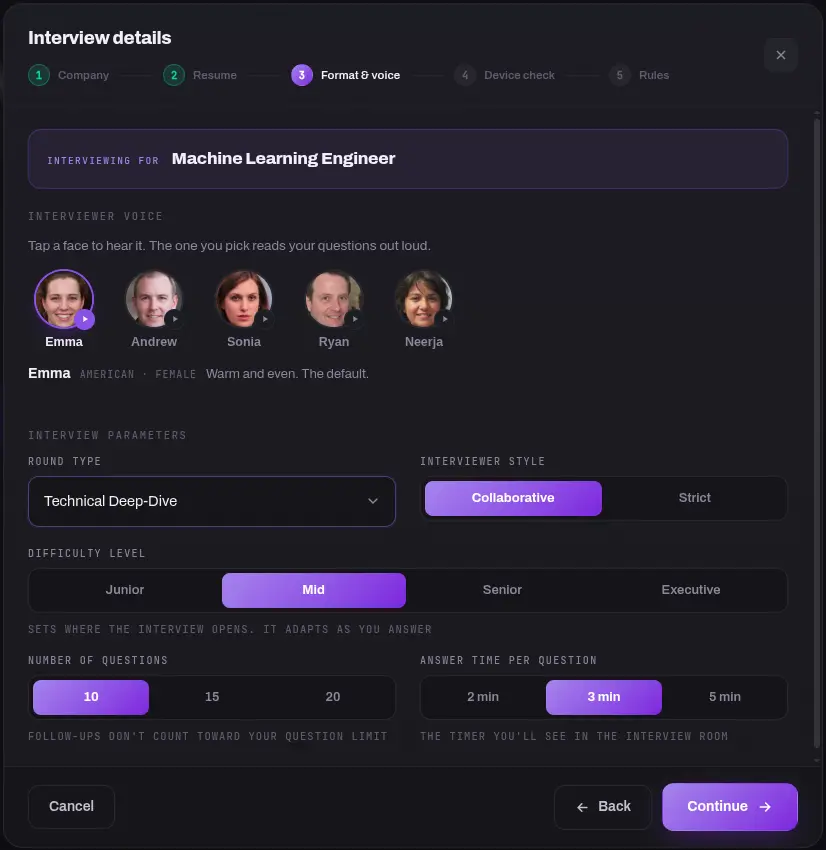
Sit the interview
Questions are asked out loud, one at a time. Answer by speaking, typing, or writing code. A thin answer gets a follow-up on the same topic; a strong one makes the next question harder.
Voice, text or code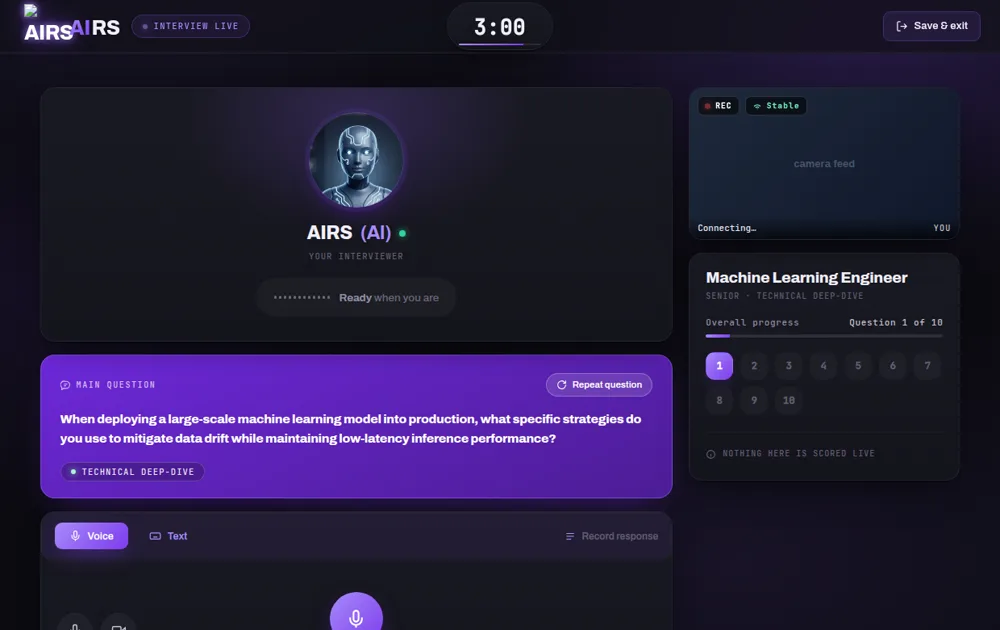
Read the debrief
The moment you finish: what to keep doing, what to fix, how you sounded, and whether you came across calm, nervous or assertive. Every point is tied to something you actually said.
Debrief in seconds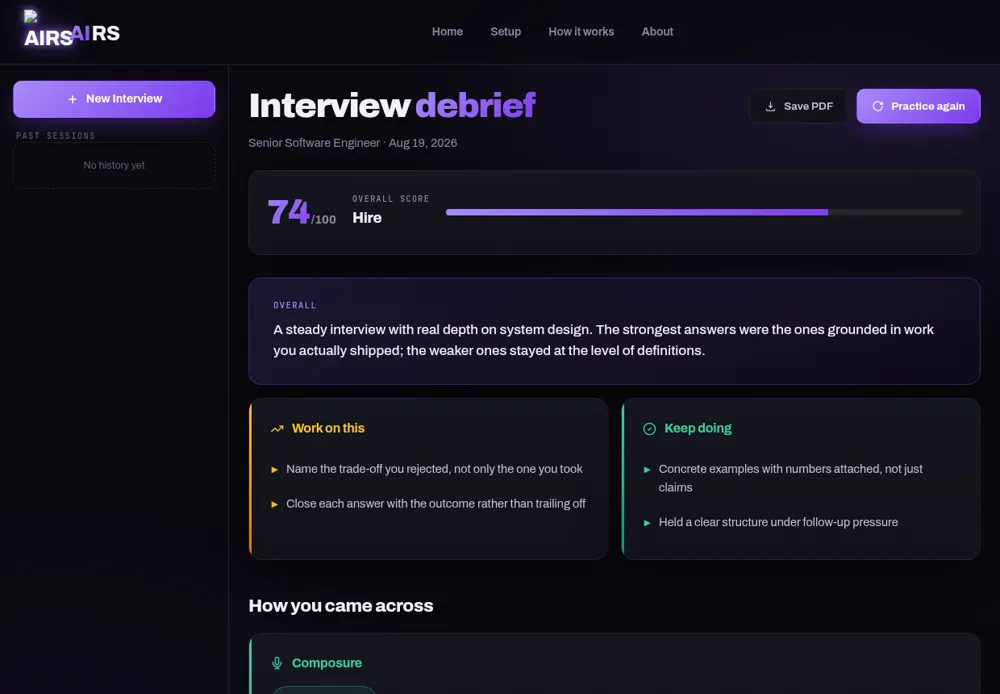
Questions before you start
Do I need a job description?
No. Every role in the list carries its own description, which is what the interview is built from. If you type a role that isn't listed, the interview is built from the title and your resume instead.
Do I have to speak, or can I type?
Either. Typing works for the whole interview, and coding rounds open a real editor. Speaking gets you the delivery and composure analysis, because those are measured from the audio, so there is nothing to measure on a typed answer.
What happens to my resume and my recordings?
Your resume is stored as text on your own session and used to generate questions. Recordings are not kept at all: each answer is transcribed and analysed in memory, then dropped. What survives is the transcript and the measurements.
How long does an interview take?
10 core questions, up to three minutes each, plus follow-ups when an answer needs one. Most sessions run 15 to 25 minutes, and the debrief is ready within seconds of finishing.
Can I stop halfway?
Yes. Save & exit ends the session and still produces a debrief covering the questions you did answer, marked clearly as an early exit so it isn't read as a full interview.
What is free, and what is Pro?
Free gives you three interviews a month with the written coaching, the delivery analysis and the composure read. Pro removes the monthly cap and adds your score and verdict, the answer-by-answer breakdown, and resume fixes for the role you picked.
Interview details
Target company
OptionalSelect a company for a more tailored interview, or continue with a general interview.
Your resume
Interviewer voice
Tap a face to hear it. The one you pick reads your questions out loud.
Interview parameters
One quick check before you go in. Nothing is recorded here, and nothing leaves your browser.
Say something once your microphone is on, for example "Hello, I'm ready for my interview."
Your interviewer speaks the questions out loud. Play a line and confirm you can hear it.
Seven things worth knowing. They take longer to go wrong than to read.
- Ten questions. Drawn from the role and your resume, with difficulty adapting to your performance.
- Three minutes each. The clock starts with the question and automatically moves to the next question when time runs out.
- Speak or type. Questions are read aloud. Answer verbally and your response will be transcribed automatically, or switch to typing at any time.
- Follow-ups are free. If your answer is incomplete or needs clarification, the interviewer may ask follow-up questions. Follow-ups do not count toward your 10 questions.
- Clarify when needed. If a question is ambiguous, you may ask for clarification before answering. Making reasonable assumptions and explaining them is part of the evaluation.
- Don't skip. If you're unsure, explain your reasoning, make an assumption, or give a partial answer. An attempted answer is better than leaving the question unanswered.
- Feedback afterwards. Get specific feedback on technical depth, problem-solving, communication, clarity, and areas to improve before the real interview.
10 questions · 3 minutes per question